From Breath
2024 – ongoing. Performance, sound, silverpoint on canvas, silver flute.
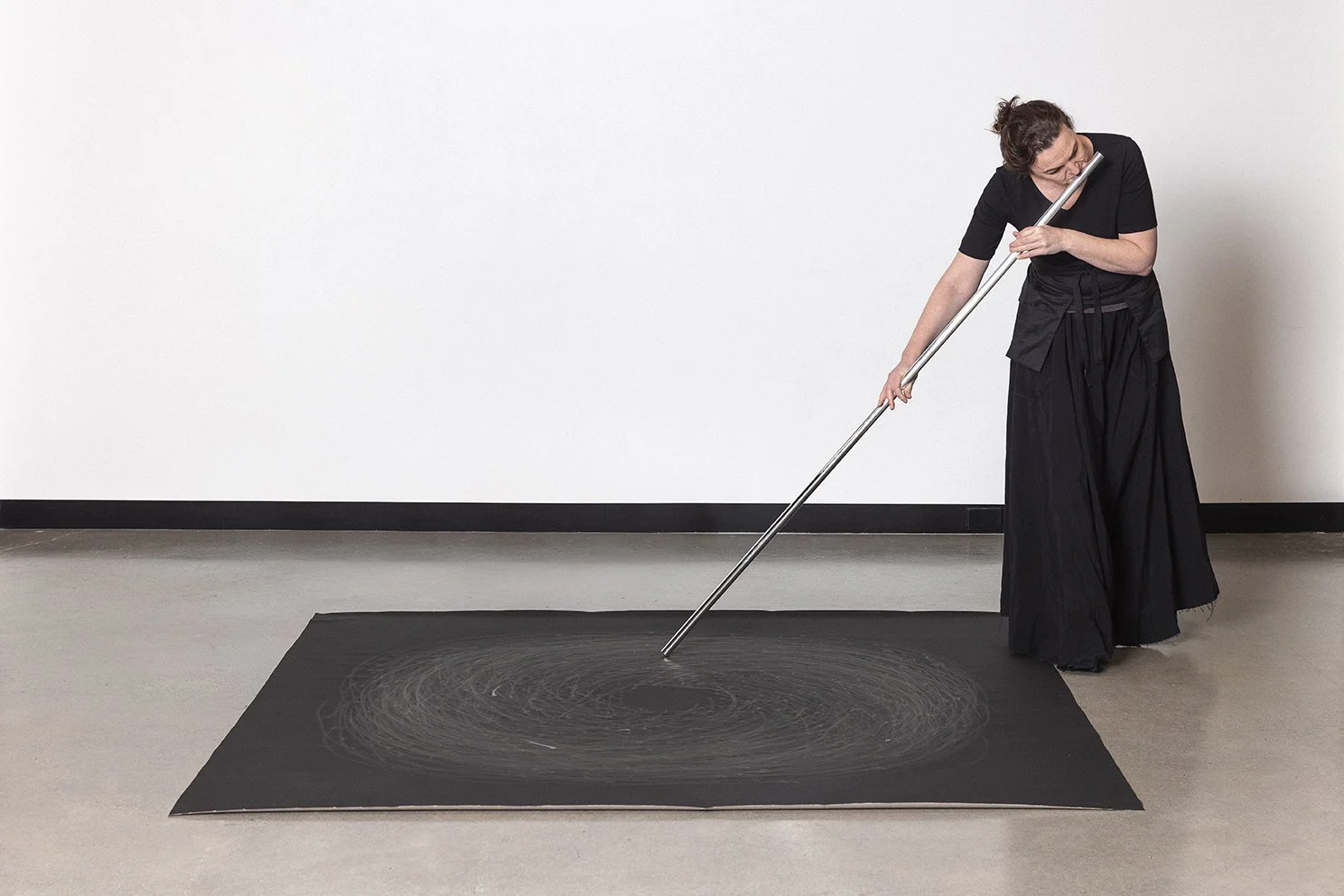
From Breath — Studio, 2024
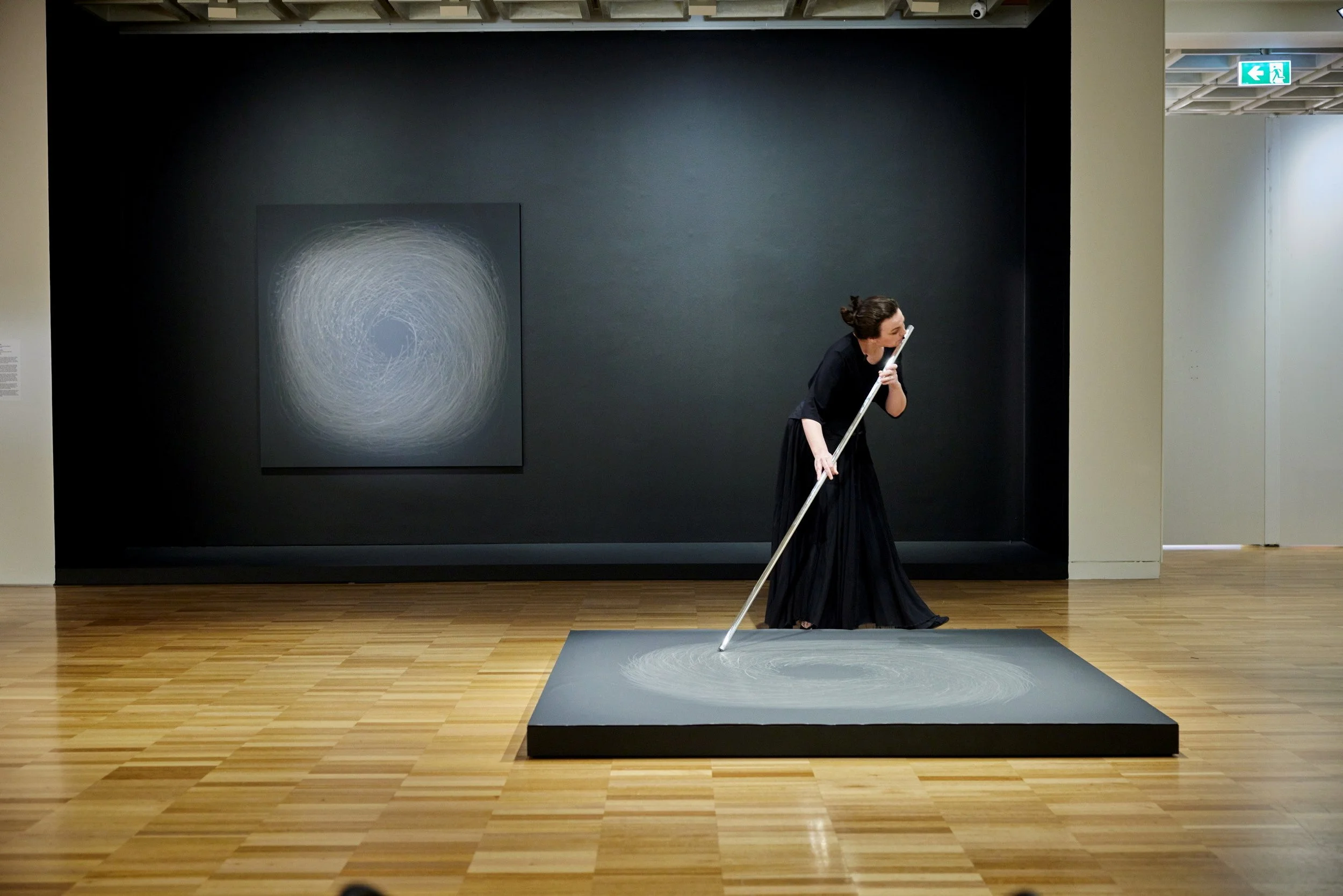
From Breath — Art Gallery of New South Wales, 2024
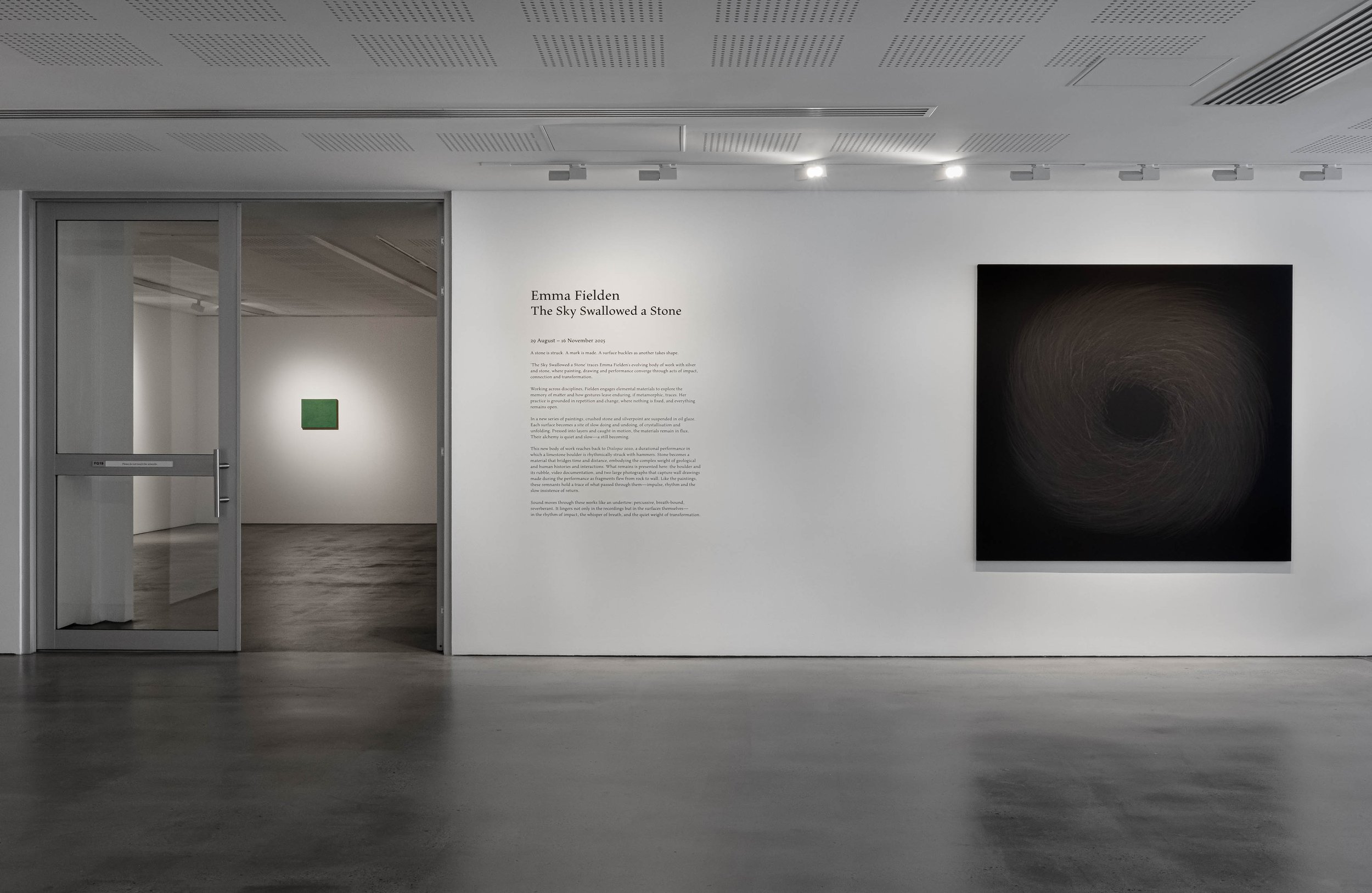
From Breath — UNSW Galleries, 2025
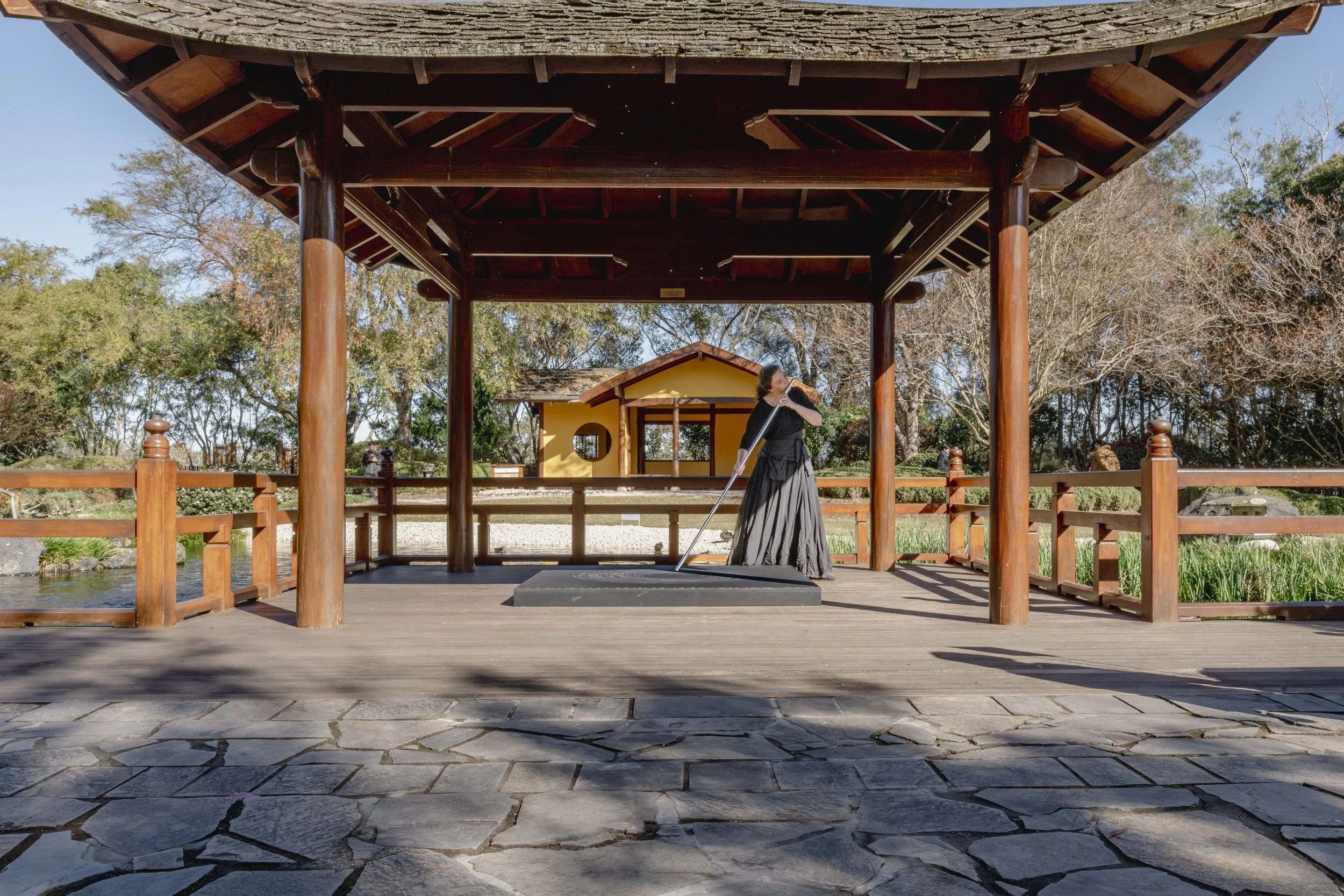
From Breath — Gosford Regional Gallery, 2025
Breath — by Julie Ewington
EXCERPT FROM THE CATALOGUE ESSAY BREATH, SILVER, STONE, METAMORPHOSIS.
Fielden’s earliest creative practice, from the age of seven until her early 20s, was being a classical flautist. Playing the flute really well, as Fielden does, requires focused bodily control, particularly of the breath. Making was therefore already somatic, long before Fielden turned to making jewellery, sculpture, installation, video. And when the artist decided in 2023 to make an oversize flute from silver, it was with a material familiar in her adult life as a jeweller; she drew on long knowledge of both instrument and metal. The best flutes are made of silver, prized equally for its resonance and longevity. But Fielden’s giant flute, which is the length of her arms from fingertip to fingertip—“the measure of an embrace”, as she writes¹—is an eccentric child of the two parents, music and silversmithing. Being silver, Fielden’s flute both makes sound and leaves its mark. From Breath 2024, the recording here, attests to the plaintive notes this flute makes; the two large From Breath 2024 drawings on canvas manifest the repeated circling movements made by the artist with the flute. Tiny silver scrapings mark the canvas, tracing the artist’s body as it circled this square black canvas. (If we look and listen closely, we might be able to exactly track the two—sound and silver.) 15 This is a nice convergence: silverpoint is an ancient technique, best known for its use by late medieval and Renaissance artists. Not entirely coincidentally in the context of Fielden’s work, which also extends to fine engraving, silversmiths and goldsmiths use fine metal points to mark designs onto metal. Historical silverpoint was always diminutive, but Fielden’s large canvases measure the exact span of her two outstretched arms, a deliberate choice. So, this is a field for action, whether the canvases are on the ground, as they were when Fielden performed the silverpoints into being, or on the wall, as they are now. Stand in front of a From Breath canvas: it will encompass you in its insistent circle, framed by that resolute square. That square is crucial to Fielden’s proposition; indeed, black squares are central to the inheritance of twentieth century Modernism. One may recall Kasimir Malevich’s Black Square of 1915 or American Ad Reinhardt’s series of (ostensibly) square black paintings made between 1953 and 1967. Yet, here, the uncompromising form of that perfect black square is occupied by Fielden’s reiterated circling silvery sounding movements. We see immediately that these many fine marks were made by repeated action—seven hours in total, one hour each day—when the work was first exhibited at the Art Gallery of New South Wales in 2024.²
¹ Emma Fielden, communication with the author, July 2025
² The From Breath suite was developed for ‘Infinite: Dobell Australian Drawing Biennial 2024’, Art Gallery of New South, Sydney, 14 September 2024 – 12 January 2025.